


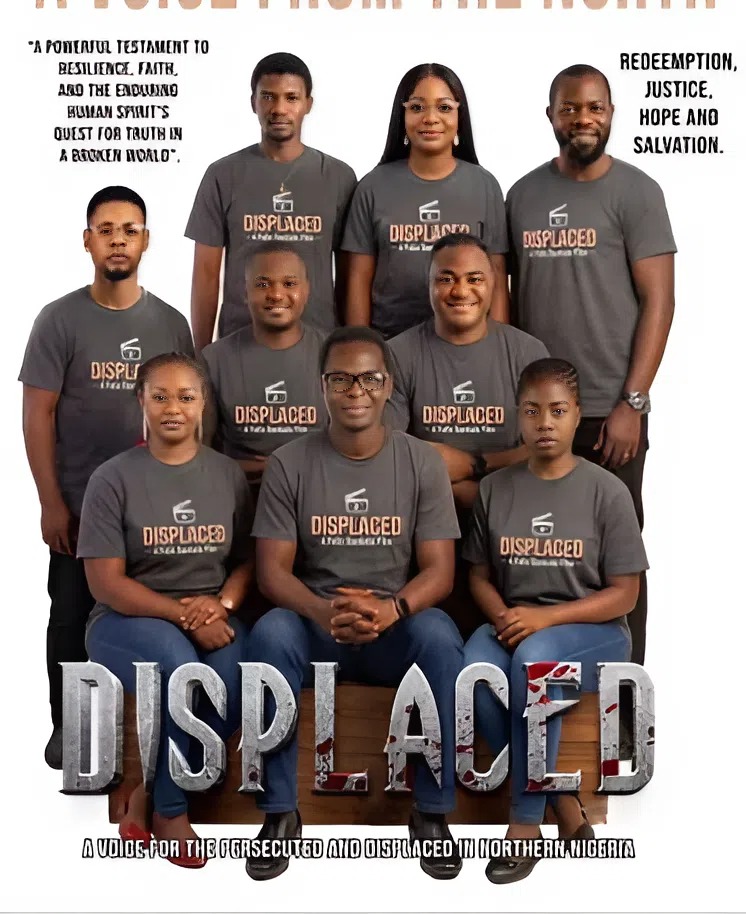
For Felix Bankole, the story of “Displaced” began long before the cameras started rolling. It began with stories of families uprooted by violence, Christians confronting persecution and communities struggling to survive after losing almost everything.
A filmmaker and drama missionary, Bankole has spent years using Christian media as a tool for evangelism. But with Displaced, he ventures into some of the most painful realities surrounding displacement in Northern Nigeria, using the story of one man to explore grief, faith, abuse, hypocrisy and the search for justice.
Bankole, President of Vision Drama Missions Outreach International and founder of Vision Film Academy, has produced more than 50 faith-based films and taken Christian media evangelism to more than 30 African countries. Yet he regards Displaced as a different kind of project, both in scale and in the difficult questions it asks.
The decision to set the film in northern Nigeria was deliberate. For Bankole, the region is not merely a backdrop for a dramatic story but a place where the consequences of violence, displacement and insecurity are experienced by real families.
At the centre of the story is Haruna, a character whose experiences reflect the realities of survivors who have lost their homes, loved ones and possessions but continue to hold on to their faith.
Haruna’s grief becomes the emotional engine of the film. Faced with devastating loss, he could easily surrender to anger or seek revenge. Instead, his journey gradually takes him towards truth and justice.
That transformation is central to what Bankole wants audiences to understand: suffering does not necessarily have to end in despair or vengeance. Pain, when confronted with courage and faith, can become a source of purpose.
But Displaced does not present its characters with easy answers. The film confronts medical neglect, sexual abuse, corruption and religious hypocrisy, forcing audiences to look beyond the familiar themes of faith and triumph often associated with Christian cinema. For Bankole, this was necessary because the gospel should not be confined to comfortable conversations. Faith, he believes, must also speak to people experiencing the darkest moments of their lives.
The film consequently challenges not only the violence outside religious institutions but also the failures that can occur within them.
One of the most striking examples is Pastor Dauda, whose character exposes hypocrisy and institutional shortcomings. Through him, Bankole turns the spotlight inward, asking difficult questions about the responsibilities of church leaders and Christian communities.
The filmmaker hopes the story will encourage conversations about protecting vulnerable people, financial transparency, abuse and the responsibility of churches to support persecuted Christians.
Rather than portraying Christianity through perfect characters who have an answer for every problem, Bankole said the film embraces realism. Its characters experience anger, grief and uncertainty, allowing the Christian message to emerge naturally from their struggles.
This realism also extends to the film’s depiction of trauma. Bitrus and Hannatu represent different ways of responding to suffering. While one embodies the determination to confront systemic injustice, the other represents healing, endurance and communal support.
Together, their stories suggest that rebuilding a life after displacement requires more than physical safety. Survivors also need justice, emotional healing and communities willing to stand beside them.
Making the film was itself an emotional and logistical challenge.
Bankole said recreating the atmosphere of displacement camps and insecurity required sensitivity from the cast and crew. Some scenes became so emotionally heavy that members of the production team were left in tears.
The experience was particularly personal for Bankole and his team, who have encountered insecurity and threats while working on mission projects, including efforts to build schools and mission houses in vulnerable Northern communities.
Security, locations and the psychological burden of filming difficult scenes all tested the production team. Prayer, Bankole said, became an important part of sustaining the project.
Shot in Nigeria and the United States, Displaced also benefited from cross-border collaboration with international missions and partners. The production represents a significant departure from the more conventional settings of many faith-based dramas, taking audiences into displacement camps, rugged landscapes and environments shaped by insecurity and institutional corruption.
For Bankole, however, the technical ambition of the project is secondary to its message.
He does not want audiences to watch Displaced, feel sorry for the characters and simply move on. He wants the film to provoke action.
He wants church leaders to examine their institutions, Christian communities to confront hypocrisy and viewers to consider what it means to stand with vulnerable people when doing so is difficult.
Ultimately, Displaced is a story about what people do with pain after everything familiar has been taken away.
It is about a man whose grief becomes a search for truth, a community struggling to heal and a faith tested by violence and betrayal.
For Bankole, the film carries a simple but powerful conviction: oppression may destroy homes, violence may uproot families and hypocrisy may wound communities, but none should be allowed to have the final word.
In Displaced, he hopes truth, hope, forgiveness and redemption will ultimately speak louder.